Effort to ban lab-grown meat — and maybe crab rangoon — underway in West Virginia House

There’s a legislative effort to outlaw lab-grown meat in West Virginia.
The House of Delegates is set to consider a Republican-backed measure, House Bill 4462, that would ban the manufacturing and sale of cell-cultured food products in West Virginia.
Lead bill sponsor Del. Scot Heckert, R-Wood, told lawmakers that there’s “a concern of what it’s going to do to the human body.”
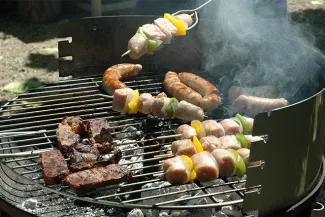
Meats and kababs cooking on a grill. Wikimedia - DimiTalen.
A cell-cultured product is a food product derived by harvesting animal cells and artificially replicating those cells in a lab. The created tissue product is meant to resemble the texture, flavor and appearance of meat, fish, eggs and more.
During debate, Del. Kayla Young, D-Kanawha, questioned why the bill was necessary and noted it could possibly ban the popular Chinese-American appetizer crab rangoon — a deep-fried wonton typically filled with imitation crab meat and cream cheese — in West Virginia.
“I thought we didn’t want the government up in everybody’s business all the time, but that’s exactly what this bill is doing,” Young said. “I also don’t really want to ban crab rangoon, so I’m going to be a no.”
Heckert told lawmakers that the bill was brought to him by the Cattlemen Association and Beef Association.
Selling lab-grown meat “could hurt the farmers that actually are part of what made this country what it is, and provide us with beef, good quality beef without antibiotics or steroids or synthetics or, who knows what else is in that vat that mixes that stuff together,” Heckert told members of the House Government Organization Committee on Feb. 5.
Del. Dave Foggin, R-Wood, voiced support for the measure.
“I don’t care if people eat the styrofoam out of their couch cushions. It don’t matter to me,” he said. “I have the uncanny ability to foresee the future, and sometimes products like this are made very cheaply in huge quantities, and it won’t be long before we’re feeding them to our school children for a profit.”
© tussik13 - iStock-908521486
Democratic members of the House Government Organization Committee voiced opposition to the measure mostly centered on government overreach and potential lawsuits.
Del. Hollis Lewis, D-Kanawha, said that labeling the products as cell-cultured or lab-grown should suffice.
“It’s overreach for us to just ban them outright,” Lewis said. “People have freedom of choice, so if they want to consume these products, let them, as long as there’s clear labeling.”
The House Government Organization Committee passed the legislation Monday, and it now heads to the full House for a vote.
Alabama, Florida and other states have banned lab-grown meat, and more states are considering similar legislation.
The Florida-ban is currently being challenged in court after Upside Foods, a company specializing in cultivated chicken products, sued the Florida Department of Agriculture and Consumer Services last year.
Upside Foods said that the Florida ban violated the U.S. Constitution’s Commerce Clause, which restricts states from imposing limits on interstate trade.
“The Florida law that this is an exact replica of this is being held up in court because of the Commerce Clause and litigation is expensive,” Young said. “I don’t know why we want to get into that.”
The bill doesn’t include any potential penalties.