Great Plains tribes focus on a different anniversary as US celebrates its 250th

Trina Lone Hill is not excited about the July 3 fireworks display at Mount Rushmore to commemorate the nation’s 250th birthday.
Tribal leaders across the region have emphasized the need for better dialogue, as the retiring Standing Rock chairwoman recently called for increased communication with South Dakota officials.
“I actually find it offensive,” said Lone Hill, an Oglala Sioux Tribal Council member and former tribal historic preservation officer from Batesland, on the Pine Ridge Reservation.
State and federal officials “don’t care if we’re resisting, they don’t care if we have opinions,” she said. The Black Hills, where Mount Rushmore is located, is “our sacred place,” she added.
The Lakota creation story is tied to Wind Cave in the Black Hills, and multiple sites in the Black Hills correspond with celestial features in Lakota spirituality. Lakota people controlled the Black Hills and all of western South Dakota pursuant to an 1868 treaty that the U.S. government later broke.
The fireworks display at the mountain carving is one of more than 1,000 events planned across the United States to commemorate the 250th anniversary of the country’s independence.
Instead of observing the nation’s birthday during the Fourth of July weekend, Lone Hill’s focus is on an event this week: the 150th commemoration of the Battle of the Little Bighorn.
Known to Lakota people as the Battle of the Greasy Grass, the conflict was a major victory for tribes during the United States’ encroachment on their land after the discovery of gold in the Black Hills. Northern Cheyenne, Arapaho, Dakota and Lakota warriors and leaders wiped out the Army’s 7th Cavalry, including the famed commander George Armstrong Custer, on June 25 and 26, 1876, in what later became the state of Montana.
This year, there’s a cooperative effort by the National Park Service and tribes in multiple states to mark the 150th anniversary at the Little Bighorn Battlefield National Monument. The three-day event Thursday through Saturday is expected to attract up to 10,000 attendees. The schedule includes speakers from South Dakota-based tribes, including Lone Hill and Ryman LeBeau, the chairman of the Cheyenne River Sioux Tribe.
“The 150th for us is a priority, just bringing that pride back to our people,” Lone Hill said. “This is something I said we have to keep going for our families. We can’t lose that history.”
‘Complex relationship’ with tribes affects America 250 efforts
The state’s America 250 commission — a group of Cabinet members, the state historian and other appointees formed by an executive order by then-Governor Kristi Noem — includes Department of Tribal Relations Secretary Algin Young, a member of the Oglala Sioux Tribe. He has been working to connect with tribal leaders about the group’s efforts to commemorate the country’s 250th anniversary.
“As we commemorate America’s history, it’s essential to recognize how deeply it is connected to the heritage of South Dakota’s nine tribal nations,” Young said.
Young hasn’t heard back from many of the tribal leaders, he said. He wants to know if tribes are planning gatherings or commemorations of their own, and how the commission can support those efforts.
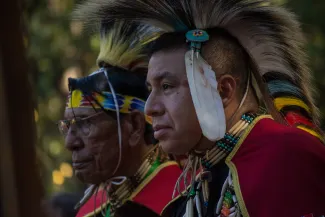
© ~UserGI15632746 - iStock-579416018
But, “it’s a complex relationship,” Young said about the dynamic between the tribes and the state.
Former Governor Kristi Noem, who left her post in 2025 to serve as head of the national Department of Homeland Security, was at one point banned from all nine of South Dakota’s tribal nations after alleging, without providing evidence, that tribal leaders were “personally benefiting” from drug cartel activity on reservations and after saying Native American children “don’t have any hope.”
Young said Noem’s successor, Governor Larry Rhoden, is working on repairing relationships between the state and tribal nations.
“It’s a reset,” Young said. “I’m very hopeful that those relationships are rebuilt and we move forward together.”
Boyd Gourneau, chairman of the Lower Brule Sioux Tribe, acknowledged that he doesn’t have a strong relationship with state leaders. He praised the late Governor George Mickelson’s efforts to build strong communication and trust during his 1990 Year of Reconciliation.
“We really haven’t went forward since then,” Gourneau said. “I’m not saying we’re perfect, that that door swings both ways. We need to improve as well. I understand that, but I think we could all be better, and we all should work towards that.”
Gourneau hasn’t been involved in America 250 planning. But he plans to use the Fourth of July to recognize the military service of people around him, like his son.
“I don’t know if it’s a celebration, but I’m going to honor them. I am touched by their sacrifice. So, I’m not going to say I don’t care,” he said of America 250 events, “but it’s secondary to what we’re doing at Little Bighorn.”
Differing views of the declaration
Ben Jones, state historian and chair of the state’s America 250 Commission, shares Young’s goal of an inclusive celebration of the anniversary. But Jones said unreturned phone calls, emails and invitations showed that tribal leaders in the state weren’t interested.
“That was disappointing,” he said. “The Declaration of Independence is for all.”
There are many misunderstandings and misinterpretations of the Declaration of Independence, Jones said, “and that misunderstanding isn’t improved when today you choose not to participate, and to have some informed discussions about why that language exists.”
Lone Hill has a different view.
“For me personally, the 250th anniversary of the signing of the Declaration of Independence is like a slap in the face,” Lone Hill said. “In that Declaration of Independence they call us ‘merciless Indian savages.’”
Lone Hill was referencing the declaration’s list of the British king’s alleged “injuries and usurpations.”
“He has excited domestic insurrections amongst us,” that part of the declaration says, “and has endeavoured to bring on the inhabitants of our frontiers, the merciless Indian Savages.”
The relationship between tribal nations and the United States since the declaration has been “like a rollercoaster,” according to Craig Howe, founder of the Center for American Indian Research and Native Studies on the Pine Ridge Reservation.
The signing of the Declaration of Independence might not have had immediate effects on tribes in North America’s interior, Howe said, but as the country expanded, so did policies that forcibly removed Indigenous people from their homelands.
While this year’s anniversary is an opportunity to talk about that, Howe wants more consistent education about Native American history.
It “should be embedded in the formal educational system in our country,” he said. “We shouldn’t need some 250 years before we talk about it again. It should just be.”