Montana sees record precipitation over weekend

Snowfall over the weekend pushed the total snow depth at Lolo Pass, Montana, from 55 inches up to 90 inches, according to the National Weather Service Missoula.
The weekend’s snowfall also marked a record, said Joe Messina, meteorologist for the National Weather Service Missoula.
“It was the wettest three days we’ve had in Missoula for the month of March — any March,” Messina said.
© iStock - auerimages
The precipitation hit both sides of the Continental Divide, pushing snowpack to average or even above average in some basins in western Montana.
The moisture is going to help with dry soils in eastern Montana, but that doesn’t mean farmers are having a party.
A spokesperson for the Montana Farmers Union said weather has become less of a concern for farmers than the impact of tariffs from the Trump administration.
Walter Schweitzer, with the Montana Farmers Union, said farmers are sitting on a surplus of wheat, corn, soybeans and malting barley, not because they had good crops, but because they lost their markets.
“Right now, most farmers in Montana are just kind of looking at their options trying to figure out which crop they can plant that will lose them the least amount of money,” Schweitzer said.
Snowfall in western Montana
Snowpack has evolved in western Montana this year, Messina said.
Earlier this year, a lot of precipitation came as rainfall, but it came as snow in higher peaks, so the Snotel sites had a “high elevation bias,” he said.
“We’re below average after January, but not dangerously low like we were two years ago,” Messina said. “That was really a disastrous snow year.”
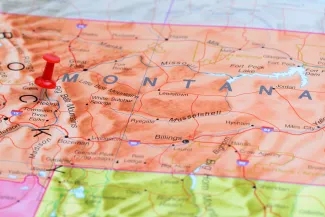
In the Rattlesnake National Recreation Area and Wilderness north of Missoula, the recent few days in March pushed snow depth from 80 inches to 110 inches, Messina said.
He said the precipitation pushed snowpack to average or even above average in a lot of the basins; the lower Bitterroot is at 98 percent; Upper Clark Fork is as much as 120 percent of average; and the Blackfoot is sitting at 106 percent of average.
He said the Flathead Lake area is at or above average as well.
But Messina stressed there’s a high elevation bias “cooked into that above-average statement,” the northwestern and southwest parts of the state remain dry, and the recent precipitation isn’t necessarily going to shield Montanans from smoke this summer.
“There’s a ways to go yet before fire season,” Messina said.
For one thing, later this week, the temperature in Missoula will hit 60 or 70 degrees, so some of the snowpack will be lost early.
He said the Flathead and the Bitterroot also will see a warming in a few days, although rain and snow are forecast in the Flathead earlier this week.
“We may see some full culverts, some ponding in low areas, some urban runoff, so that may be an issue later this week,” Messina said.
Snowfall in the Billings area
Billings received 11.7 inches of snow over four days, said National Weather Service meteorologist Logan Torgerson.
The airport, the official climate site, received 12.4 inches, he said.
Torgerson said he was not aware that Billings had hit any records, but he also said that’s roughly 50 percent more than the average for the month of March.
The official climate site at the airport is slightly below normal for the season, at 36.7 inches, whereas normal is 45.2 inches, he said.
Torgerson said he doesn’t believe the recent precipitation will have much of an impact on fire season because the most important aspect is spring rainfall.
For meteorologists, the snowfall year starts July 1, and Torgerson said Billings has had only three big snowstorms this year, in late November, in December and this past weekend.
“In Billings we are sitting at almost exactly normal precipitation for the year,” Torgerson said.
A rapid warmup is in the forecast, so Torgerson said the snow isn’t going to last long.
“Luckily, our soils are not frozen, so they should be able to absorb (the melt),” Torgerson said.”
Farmers hope for rain, worry about aftermath of tariffs
Some farmers were “freaking out” before the moisture this weekend and wondering if they were going to have enough grass and hay for the coming season, Schweitzer said.
But Schweitzer said it typically snows at the peak of calving, and the recent dump was good news in central Montana.
“There was quite a bit of snow in the Golden Triangle, which it needed,” Schweitzer said.
But he said the weather has become a secondary concern to his members, and he noted that 2025 brought a record number of bankruptcies in agriculture across the country, and 2026 is expected to be worse.
At this point, Schweitzer said tariffs are a top concern.
The Montana Farmers Union had sued the Trump administration over the tariffs, and the U.S. Supreme Court recently decided in favor of the farmers, but Schweitzer said the result is “a mess” nonetheless.
“There was a couple hundred billion dollars in tariffs that were collected, but are they going to get refunded to the people who actually paid them?” Schweitzer said.
Weather has become a secondary concern, but he said he hopes more moisture is on its way.
“I just hope it keeps snowing and raining,” Schweitzer said.