More states are requiring insurers to cover non-opioid pain meds

More states are requiring their Medicaid programs and health insurance companies to cover non-opioid pain medications as an alternative to opioids, which can be cheaper for insurers but also more addictive for patients.

© iStock - AndreyPopov
Advocates, providers, medical associations and state lawmakers are pushing for parity in coverage. That means prohibiting insurers from charging higher copayments for non-opioids than they do for opioids, and barring them from requiring prior authorization or step therapy — mandating that patients try other medications first — before they will cover non-opioid drugs.
At least eight states have enacted such laws: Arkansas, Illinois, Louisiana, Maine, Massachusetts, Oklahoma, Oregon and Tennessee. In states that are still considering legislation, the efforts have been bipartisan, pushed by lawmakers in Democratic-controlled states such as Colorado and New York and Republican-leaning states including Kentucky and Missouri.
The issue has gained momentum in recent years, as leading medical associations such as the American Society of Regional Anesthesia and Pain Medicine have urged providers not to prescribe opioids as the first-line treatment for pain. Meanwhile, bipartisan legislation introduced in Congress last year aims to increase Medicaid Part D enrollees’ access to non-opioid pain medications. It’s been referred to a committee.
Dr. Patrick Giam, president of the American Society of Anesthesiologists, said the organization “believes it is important that insurance plans make non-opioid therapies as accessible to patients as opioid-based therapies.”
Suzetrigine
The U.S. Food and Drug Administration last year approved a new drug called suzetrigine, under the brand name Journavx, the first non-opioid pain relief medication in a new class of analgesic drugs.
Non-opioid pain medications include prescription-strength anti-inflammatory NSAIDs such as naproxen and ibuprofen, nerve-blocking injections, certain antidepressants, anticonvulsant medications, acetaminophen and other medications. Opioids include oxycodone, codeine, morphine and fentanyl. The U.S. Food and Drug Administration has long encouraged non-opioid pain relief alternatives.
Last year, the agency approved a new drug called suzetrigine, under the brand name Journavx, the first non-opioid pain relief medication in a new class of analgesic drugs. The drug, which is available in tablets, can be prescribed for acute pain after surgery or injury. Vertex Pharmaceuticals, the manufacturer, is one of the funders of Voices for Non-Opioid Choices, which has been lobbying for the bills.
In Missouri, where GOP-sponsored legislation would prohibit insurance companies from denying coverage of a prescribed non-opioid or requiring a higher copayment for a non-opioid, the Missouri Insurance Coalition has argued that the measure would increase health care costs and effectively create “a monopoly” for Journavx. Each tablet can cost around $15 per tablet out-of-pocket. But lawmakers pointed to non-opioid alternatives.
Why non-opioids often cost more
Newer non-opioid drugs entering the market are more expensive than opioids because there isn’t yet a generic alternative, explained Sterling Elliott, an Illinois clinical pharmacist and lecturer at Northwestern University’s Feinberg School of Medicine and a board member of Voices for Non-Opioid Choices.
“The price is so high for a lot of things because the price for generic opioids is so low. Generic opioids are amongst the cheapest medications that you’ll find flowing through the American pharmaceutical supply,” Elliott said. “When you get a new entrant into the pain market, the marketplace factors are set up to drive the price up.”
Elliott added that some insurance plans don’t cover prescription-strength NSAIDs such as ibuprofen because they’d rather people pay out-of-pocket for lower strength, over-the-counter versions of those drugs.

© iStock - Darwin Brandis
In New York, Democratic Assemblymember Phil Steck, the cosponsor of a bipartisan bill that hasn’t received a hearing, said challenging the insurance companies isn’t easy.
“You’re trying to tell insurers what to do,” Steck said. “Those are usually difficult undertakings. … Our experience is that the [legislature’s] insurance committee is very difficult to deal with, and so it hasn’t been pursued as much as we would like.”
Coverage of non-opioids can vary widely across insurance plans, explained clinical pharmacist Emma Murter, who co-chairs the advocacy committee of the Society of Pain and Palliative Care Pharmacists.
“There are so many [non-opioid] medications that can be used for chronic pain,” Murter said. “It isn’t gut-instinct obvious, what is and isn’t covered. It’s very Wild West, chaotic.”
When it comes to filling prescriptions, Murter said, she often has to “fight and appeal for some of these non-opioid therapies” with insurance companies.
Dima Qato, associate professor of clinical pharmacy at the University of Southern California, said non-opioid pain prescription meds are less common on insurance companies’ “preferred” drug lists. Because insurers may favor the less expensive opioids, that can result in higher copayments or consumers paying more out-of-pocket.
That was the case for Chris Fox, the Washington lobbyist who serves as executive director of Voices for Non-Opioid Choices. Fox has traveled to state capitals around the country to lobby for the bills. Recently, he had a personal experience with pain medications following oral surgery.
“For everything but the non-opioid, my out-of-pocket expectation was $0,” he said. He was charged $30 out-of-pocket for the non-opioid.
His oral surgeon wasn’t familiar with the availability of the new first-in-class non-opioid suzetrigine, Fox added. When he asked the doctor for a prescription for it, the surgeon wrote it but also prescribed an opioid along with an antibiotic.
“He prescribed me hydrocodone to go along with it, just in case, because he wasn’t as familiar with [suzetrigine],” Fox said.
Preventing addiction
As he spoke with Stateline by phone, Fox was driving to the local sheriff’s office to drop off the hydrocodone, which he didn’t take following his surgery.
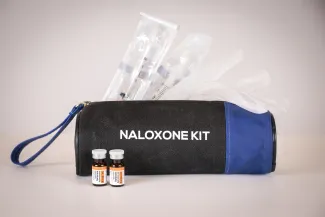
“We’ve neglected the opportunity, I would say, to prevent opioid addiction where we can, which is in those patients that will develop a newly persistent opioid use pattern following exposure to an opioid that they get for medical reason,” Fox said.
Although opioid overdose deaths have declined, the drugs still kill about 200 Americans a day.
Health care professionals at hospitals also run into issues with lower reimbursement rates for some non-opioids.
Dr. Joseph Smith, an anesthesiologist at a Virginia surgical center who has practiced for three decades, pointed to a nerve-block pain pump as an example. Administering a brand-name version of the drug could cost up to $400 for all the equipment, he said. Smith, like Elliott, sits on the board of Voices for Non-Opioid Choices.
“So the hospital is like, ‘Well, I can spend $400 or I can spend 25 cents on a narcotic pill,’” Smith said.
Smith treats many young teen athletes with sports injuries. Research has shown post-surgery narcotic use can increase risk of addiction.
“My goal when I get a 14-year-old or 15-year-old in here is to never have them try a narcotic, never have them exposed to narcotics,” he said.